Logistics and Supply Chain systems

Logistics software that follows the whole movement

A shipment is a chain of commitments, hand-offs, documents and charges rather than a pin on a map. We build operational systems that preserve the relationship between customer order, handling units, legs, events, proof and financial settlement.

Operating challenges

Problems the system must account for

CONSTRAINT 01

Multi-leg planning and costing

One consignment may travel through collection, cross-dock, line-haul, port, customs and final delivery using several carriers and currencies. Planned, accrued and actual cost must be allocated without losing which leg or handling unit caused it.

CONSTRAINT 02

Proof of delivery quality

A signature image alone may not prove the right goods reached the right location under the agreed conditions. Time, geolocation, recipient, item exceptions, photographs and device synchronisation need a defensible chain linked to the delivery stop.

CONSTRAINT 03

Changing execution events

Missed slots, rolled sailings, failed deliveries, split loads and damaged freight invalidate the original plan. Systems must re-plan remaining work while retaining the original promise, event history and responsibility for additional charges.

CONSTRAINT 04

Handling-unit visibility

Orders become pallets, parcels or containers, are consolidated, deconsolidated and sometimes relabelled. Visibility fails when tracking only the shipment header rather than maintaining parent-child handling-unit relationships at each hand-off.

CONSTRAINT 05

Carrier invoice accuracy

Invoices include fuel, waiting, accessorial, dimensional and out-of-area charges that may arrive after delivery. Automated matching needs contract versions, measured quantities and documented exceptions, not a comparison with one quoted total.

ERP capability matrix

Modules for logistics and supply chain operations

01

Order and Consignment Management

02

Transport Planning and Load Building

03

Route and Delivery Scheduling

04

Fleet and Driver Management

05

Warehouse Management

06

Yard and Dock Scheduling

07

Handling Unit and Container Control

08

Shipment Tracking and Events

09

Electronic Proof of Delivery

10

Freight Rating and Multi-Leg Costing

11

Carrier Procurement and Settlement

12

Claims and Exceptions

01

The gaps between an order and its delivery

Generic ERP usually records a despatch and perhaps a tracking number. It rarely represents consolidation, leg-level capacity, equipment compatibility, time windows, trans-shipment or the commercial consequences of an exception. Teams then plan in spreadsheets and enter only the final totals, losing operational explanation.

We model consignments, handling units, stops, legs, resources and events as related but independent records. Plans can change without erasing execution history. Cost ledgers separate quotation, expected carrier cost, accrual, invoice and customer charge so margin is explainable at shipment and leg level.

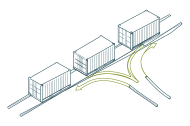
  • Parent-child tracking through consolidation and deconsolidation
  • Planned, estimated and actual timestamps kept separately
  • Charge allocation by weight, volume, distance or agreed rule
02

Integrating partners across an uneven network

Carriers and customers may offer modern APIs, EDI messages, portal downloads, spreadsheets or only scanned documents. Telematics devices generate frequent positions while ports and customs brokers publish sparse milestone events. The integration design normalises these signals without presenting inferred data as confirmed fact.

Each event retains source, source time, receipt time and confidence or confirmation status. Idempotent ingestion handles repeat messages; sequence rules tolerate late arrival. Document capture links labels, manifests, customs references and proof to the operational record, while partner-specific mapping remains versioned and testable.

03

A corridor-by-corridor rollout

Initial discovery follows representative shipments from booking to settlement, including failures and manual workarounds. A pilot is bounded by service type, depot or trade lane so planners, warehouse teams, drivers and finance can validate the full lifecycle. Open consignments are migrated only with sufficient event and cost context.

Expansion adds partner connections, optimisation and customer self-service after core transaction quality is stable. Cutover includes device provisioning, label continuity, offline delivery capture and fallback dispatch procedures. Daily controls reconcile loaded units, undelivered stops, missing proof, uninvoiced shipments and unmatched carrier charges.

  • Pilot a complete operational and financial lane
  • Prove offline capture and delayed-event handling
  • Scale partner onboarding through reusable interface controls
FAQ

Logistics and Supply Chain software questions

How does logistics software calculate profit on a multi-leg shipment?

It records expected and actual revenue and cost against each leg, service and accessorial charge, then allocates shared amounts by an agreed basis. Late carrier invoices update the financial view without rewriting the operational plan.

Can electronic proof of delivery work offline?

Yes, an authorised device can capture stop, recipient, timestamp, signature, photographs and exceptions while offline. Synchronisation protects against duplicate submissions and flags conflicts or incomplete evidence for review.

Can a TMS integrate with different carrier systems?

Yes, through APIs, EDI, files or controlled imports according to carrier capability. Each connector maps status, identifiers, documents and charge codes into a common model while retaining the original source reference.

What is the difference between shipment tracking and handling-unit tracking?

Shipment tracking follows the commercial movement, while handling-unit tracking follows individual parcels, pallets or containers through consolidation and splits. Both are needed when only part of a shipment is delayed, damaged or delivered.

How are carrier invoice discrepancies handled?

Invoice lines are matched against contract rates, executed services, measured quantities and approved exceptions. Differences outside configured tolerances are routed to review with the relevant shipment evidence.

Plan software around your logistics and supply chain operation.

Share the workflows, records, exceptions and integration boundaries the system needs to support. We will help define the technical scope.