Task-specific agents
We shape an agent around a bounded outcome such as research, triage or record preparation. Completion rules and escalation paths prevent an open-ended assistant from becoming an untestable product.

We engineer agents as distributed software systems, combining models with tools, state, policy checks and human approval where consequences require it.
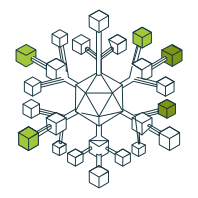
We shape an agent around a bounded outcome such as research, triage or record preparation. Completion rules and escalation paths prevent an open-ended assistant from becoming an untestable product.
Typed tool contracts connect models to internal APIs, search, databases and queues. Validation, least-privilege credentials and idempotency protect systems from malformed or repeated actions.
Permission-aware retrieval supplies current organisational context, while durable state records workflow facts. We separate authoritative records from conversational memory so summaries cannot quietly become truth.
Where specialisation is useful, coordinators delegate constrained work to focused agents. We avoid needless agent-to-agent conversation because it adds latency, cost and difficult failure states.
Scenario suites test final outcomes, tool choices and policy adherence rather than wording alone. Runtime limits, approval gates and output schemas constrain unsafe or wasteful behaviour.
Traces expose prompts, retrieved context, tool calls, token use and transitions without indiscriminate sensitive-data logging. Operators can replay failures and understand where a workflow diverged.
We map the goal, available information, permitted actions and moments requiring approval. The first specification defines when the agent must stop, ask or escalate.
APIs become narrow, typed tools with explicit authentication and side-effect semantics. Workflow state is modelled independently from the language model’s context window.
Representative and adversarial tasks are assembled before broad rollout. We score completion, unsupported claims, incorrect actions, policy breaches, latency and consumption.
Initial access is constrained and consequential actions remain reviewable. Traces and user feedback drive targeted changes to instructions, tools or workflow structure.
Useful agents combine probabilistic reasoning with deterministic software. The model may choose an approach or interpret ambiguous language, but ordinary code should enforce schemas, authorisation, limits and irreversible action rules. Treating the context window as a database creates lost state and unverifiable decisions.
We model transitions, retries, cancellation and partial completion explicitly. A queue may be appropriate for lengthy work, while an interactive assistant needs streaming and short deadlines. The resulting design remains understandable when a provider times out or a tool returns stale information.
A fluent wrong answer is inconvenient; an incorrect payment, deletion or customer update can be serious. Tools therefore expose the smallest useful operation, validate arguments server-side and carry the identity of the requesting user. Preview and approval stages separate drafting from execution.
Prompt injection cannot be solved with a warning sentence. Retrieved documents and web content are untrusted inputs, so they cannot grant permissions or redefine policy. Allowlists, data classification, output validation and hard execution limits provide controls outside the model.
Agents can reach a plausible answer through the wrong source or call a correct tool with damaging arguments. Evaluation must inspect the trajectory as well as the final text. We use fixed scenarios, simulated tool responses and checks for prohibited transitions, then retain human review for nuanced quality.
Changing a model, prompt or retrieval index can alter behaviour far from the edited case. Regression suites and trace comparison make those changes visible. The right production measure is completion of the bounded task within policy, not how convincingly the agent converses.
A chatbot primarily exchanges messages, while an agent maintains workflow state and can use tools to complete a bounded task. That additional agency requires stronger permissions, testing and recovery design.
Yes, through restricted APIs and authenticated tool calls. We normally separate proposed changes from committed changes and require approval for sensitive or high-impact records.
No. Multiple agents are justified when tasks have genuinely distinct context or controls; otherwise they increase cost, latency and debugging difficulty without improving the outcome.
Safety comes from controls outside the model: narrow permissions, validated tools, policy checks, limits, approval gates and auditable state. Instructions help behaviour but are not an authorisation mechanism.
Yes. We can trace its workflows, assemble representative scenarios and assess tool selection, factual support, policy compliance, resilience and operating cost.
Share the problem, current system and constraints. We will respond with the questions needed to define a credible next step.