
We engineer the
hard part.
We build custom AI models, the ERPs that run a business end to end, and the infrastructure behind crypto exchanges. We also make Deploy Bridge, our own platform for shipping software to servers you own.
- Custom AI models
- Enterprise ERP
- Crypto & Web3 infrastructure
- Full-stack engineering
- Digital marketing
- Deploy Bridge
Broad range.
Serious depth.
We don't specialize in an industry; we specialize in complexity. Whether mapping an entire manufacturing supply chain into a bespoke ERP, or building the matching engine for a new crypto exchange, Genisys engineers take ownership of the outcome.
The breadth is deliberate. Systems that are hard to build are usually hard because they sit across disciplines: a trading venue is an accounting problem before it is a latency problem, and an ERP is a data-migration problem long before anyone opens a design file. A team that owns one layer hands the seams back to you. We take the seams.
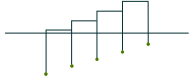
Domain first
We build a working understanding of your domain before implementation starts. Expensive rework usually traces back to a misread business rule rather than a misplaced abstraction.
One team throughout
The engineers who scope the work are the ones who write it and hand it over. Nothing is relayed through a layer that was not in the room when the constraints were set.
Written while it is fresh
Architecture decisions, failure modes and operational notes are recorded during the build, not reconstructed from memory once the team has moved on.
AI & Machine Learning
Custom model training, intelligent agents, and R&D for organizations seeking serious capabilities, not wrappers.
Enterprise Systems
ERPs, accounting stacks, and legal software built to match your exact workflows. React, Node, C#, and PHP depth.
Crypto & Web3
Exchange development, distributed ledgers, and institutional-grade blockchain infrastructure.
Full-Stack & Open Source
Product engineering across React, Node, C# and PHP — and open source projects taken on with the same rigour as client work.
Digital Marketing
Search, paid media, content and lifecycle programmes run on tracking that has been verified, and pages fast enough to convert the traffic.
AI Engineering &
Applied Research
The interesting problems in this field are rarely the model. They are the data that has to be found, cleaned and labelled before training is possible, the evaluation that tells you whether a change actually helped, and the failure behaviour of a system that is confident when it is wrong.
We take on work where those constraints are the point — proprietary datasets, domain rules that a general model has never seen, and outputs that something downstream is going to act on automatically.
Autonomous Agents
We architect multi-agent systems that perform complex, multi-step workflows. Beyond simple RAG, we build systems capable of tool use, reasoning, and independent execution.
Model Development
Fine-tuning and custom model development for domains where generic APIs fail. We handle the data pipelines, the training infrastructure, and the final deployment.
R&D Services
For unprecedented problems, we act as an outsourced research lab. We prototype, benchmark, and scale novel AI solutions for proprietary datasets.
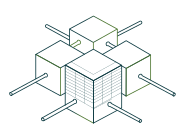
Enterprise Systems &
Core Infrastructure
Off-the-shelf software asks you to change your business to match its limitations. We build custom ERPs, accounting stacks, and legal software the other way round — designed around how you already operate.
These systems are judged over years, not at launch. They accumulate history, they become the record other departments reconcile against, and they are inherited by people who were not there when they were specified. That is what the architecture is for: clear module boundaries, an explicit data model, and behaviour that can be audited long after the original team has moved on.
Resource planning
Production, inventory, procurement and finance modelled on the way an operation already runs, rather than on a vendor template that the operation is asked to bend around. The migration of the data that already exists is treated as part of the build, because it is usually the part that decides whether the system is adopted.
Accounting and finance
Ledgers, reconciliation, tax treatment and reporting designed to survive an audit. The chart of accounts is settled before the first screen is drawn: it is the one decision that is expensive to revisit once transactions have been posted against it.
Legal and case management
Matter management, document workflow, time capture and billing for firms whose internal process is the product. Permissions and retention rules are modelled explicitly, because in this domain who saw a record is itself a record.
Institutional
Crypto Infrastructure
The stakes in decentralized systems are absolute. We engineer resilient matching engines, custody solutions, and smart contracts for organizations where failure is not an option.
- ⬡Centralized & Decentralized Exchange Development
- ⬡High-throughput Matching Engines
- ⬡Smart Contract Architecture & Auditing
- ⬡Custom Blockchain Networks
Built on Open Source.
Committed to Open Source.
Most of what we build stands on open source, and open source projects are part of the work we take on. Reading the layers below your application is how a problem gets fixed at its source instead of designed around.
It also decides what you own at the end. A system assembled from components you can read, fork and host yourself can be handed to another team, audited by a third party, or moved to different infrastructure without a renegotiation. That is a commercial property of the architecture, not a philosophical one.
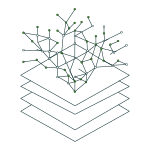
Fixes go upstream
When a dependency is the cause, the patch belongs in the dependency. A fix held privately in your repository is a liability you inherit again at every version bump, and it is invisible to the next engineer who hits the same defect.
Read the layer below
Depending on something is not the same as understanding it. Reading the source of the runtime, the driver or the library is how a problem gets resolved at its cause instead of designed around in application code that then has to carry the workaround forever.
Maintained, not abandoned
A repository with a company name on it is a commitment rather than a marketing asset. We publish work we intend to keep maintaining, and where a project is retired or its support is limited, the repository says so instead of being left to look active.
Deploy puts your code
on your own server.
Point it at a repository and a Linux machine you own. It works out how the project builds, containerises it, and brings it up over SSH — with an agent that diagnoses failed steps and attempts a bounded number of fixes, stopping for you before anything destructive.
- Analyse sourceok
- Compile blueprintok
- Connect over SSHok
- Build imageok
- Start containersheld
The agent proposes a fix, the reason it thinks the step failed, and how risky the command is. Nothing outside the allowlist runs until someone approves it.
A decision that never arrives is abandoned, not assumed.
Source
A Git URL or an uploaded archive is imported and analysed into a build blueprint.
Blueprint
Stack detection writes a Dockerfile, a Compose file and the environment it needs.
Your server
Over SSH to a Linux host you own: Docker, Compose and Nginx, then build and start.
Domain
Optional. Bind one and it sets the DNS record, origin certificate and Nginx vhost.
Your hardware
Deployments land on a Linux server you register and control.
You keep root
Access is over SSH with credentials you provide. Your app runs on your machine, not on a Genisys-managed runtime.
Docker Compose
Standard containers and a Compose file you can read, not a private runtime.
Approval gated
Unrecognised or destructive commands never run unattended.
The Genisys Standard
Four commitments that shape how an engagement is run, whatever the discipline. They describe the part of the process a client feels months after launch, which is why they are set out here rather than left implied. Specific obligations are set by each engagement's own agreement.
Built to run, not to demo.
A demo has to work once. A production system has to keep working when the data is messy, the load is uneven and the person who understood it has moved on. We design for the second case: explicit failure modes, observable behaviour, and handover documentation written while the context is still fresh. Ongoing support and response commitments are agreed per engagement and written into the contract.
You work with the engineers.
Requirements lose detail every time they are relayed. The people writing the code are in the conversation about what it has to do, so constraints surface while they are still cheap to act on. Before implementation starts we build a working understanding of the domain, because expensive rework usually traces back to a misunderstood rule rather than a misplaced abstraction.
The unglamorous parts are the work.
Migration, backfills, reconciliation and the reports finance actually opens are where most projects are won or lost, and they are the first things cut when a schedule slips. We scope them at the start and treat them as delivery rather than as cleanup, because a system nobody can move their existing data into is not in production however complete the feature list looks.
Handover is part of the build.
You should be able to take what we build to another team without a negotiation. That means readable infrastructure, documented decisions and no dependency on us for routine operation. How ownership of the code, the credentials and the data is allocated is settled in the engagement agreement rather than left to assumption.
Build it right.
If you have a complex engineering challenge, we are ready to analyze it.
The first conversation is with an engineer rather than an account manager. Bring the problem in whatever state it is in — a specification, a failing system, or a paragraph describing something you have not been able to get built.
Tell us the constraint
Not the feature list — the thing that has to be true for the project to work. The integration that cannot go down, the report finance signs, the migration nobody wants to own.
We look at it properly
An engineer reads the problem before anyone quotes on it. If the answer is that you do not need us, or need a smaller piece of work than you asked about, that is what you will hear.
Scope in writing
What is being built, what it depends on from your side, how it is handed over, and what support is included. Agreed before implementation starts.
Direct contact details are being finalised.