
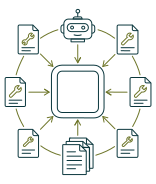
AI Agents systems

Agents judged on what they complete, not on what they say

An agent that answers questions is a chat feature. An agent that books, files, refunds or deploys is an operator holding credentials, and it needs the same treatment as one: a defined set of tools, explicit limits on each, a person in the loop wherever the action cannot be undone, and a record of everything it did. We build agent systems around those boundaries rather than adding them once something has already gone wrong.

Operating challenges

Problems the system must account for

CONSTRAINT 01

Deciding what the agent may touch

The useful agent is the one holding credentials, which is also the dangerous one. Every tool needs its own scope, rate limit and blast radius, and the permission list has to be positive: enumerate what is allowed rather than attempting to name every way a request could be abused.

CONSTRAINT 02

Recovering from a wrong step

Agents fail mid-sequence, having already completed three actions. Compensating actions, idempotency keys and a durable record of what was attempted matter far more than accuracy on the happy path, because a half-applied workflow is worse than one that never started.

CONSTRAINT 03

Knowing whether it works

Model output reads fluently whether or not it is correct, so watching a few runs proves very little. Task-level evaluation sets, regression runs over recorded cases and a measured completion rate are what separate a convincing demonstration from something a team can be staffed around.

CONSTRAINT 04

Cost and latency under real load

Token spend scales with retries, context length and tool chatter, none of which are visible in a prototype. Per-run budgets, context trimming, caching and a cheaper model for routine steps decide whether the economics still hold once volume arrives.

CONSTRAINT 05

Handing over to a person

Some cases must reach a human, and the handover is where most agent deployments lose the thread. The person needs the full context, the ability to correct the agent rather than restart it, and a clear account of what has already been done in their name.

ERP capability matrix

Modules for ai agents operations

01

Agent Orchestration and Planning

02

Tool and Function Registry

03

Permission and Scope Control

04

Human Approval Gates

05

Retrieval and Knowledge Grounding

06

Conversation and Task Memory

07

Evaluation and Regression Suites

08

Run Tracing and Audit Log

09

Cost and Token Budgeting

10

Fallback and Escalation Routing

11

Multi-Channel Deployment

12

Model Routing and Failover

Running today
GNX AI logo

GNX AI

A platform for deploying AI agents that carry out real tasks autonomously.

gnx.co.in (opens in a new tab)

Autonomous execution

Agents work through a task on their own rather than waiting to be prompted turn by turn.

Built-in tooling

Built-in tools let an agent search the web or reach an external service mid-conversation.

Zapier connectivity

Connecting an account grants an agent access to the Zapier catalogue of applications and actions.

Multi-channel deployment

One agent is deployed across web, API, WhatsApp, Slack and Telegram without being rebuilt for each.

Agent templates

A library of ready-made blueprints covers the common business and technical roles.

01

The agent loop is the easy part

A working loop over a capable model takes days. What takes the remaining time is everything that loop touches: the tool that must not be called twice, the record that must not be edited after approval, the customer who must not be emailed at three in the morning, the refund that needs a second pair of eyes above a threshold.

We start from the actions rather than the conversation. Each tool is given a signature, a scope, a cost, an idempotency rule and a decision about whether it may run unattended. The prompt is then written against that surface, which means changing model becomes a change of component rather than a rebuild.

  • Positive allowlists per tool rather than denylists per phrase
  • Idempotency keys on every action that touches a real system
  • Irreversible actions gated behind explicit approval
02

Grounding, and noticing when it is missing

Most agent errors are not reasoning failures. They are the model answering from memory when it should have looked something up, or answering confidently from a document that does not actually say it. Retrieval addresses part of that, but only if the agent is required to cite what it used and the answer is checked against the passage rather than against plausibility.

We build the grounding path so that an absent source becomes a visible outcome. An agent reporting that it could not find the answer is more useful than one producing a fluent guess, and considerably cheaper than one whose guesses have to be caught further downstream by a person.

03

Putting one in front of real users

The first deployment runs narrow: one task, one channel, a defined set of tools, and a person reviewing every action before it commits. That produces the evaluation set nothing else can, built from real inputs and real failures, and it does so while the agent is still unable to cause damage.

Approval is then relaxed per action rather than all at once, beginning with the reversible and low-value ones. Tracing stays on throughout: every run retains its inputs, tool calls, outputs and cost, so a regression can be replayed rather than described.

  • Review every action first, then relax approval tool by tool
  • Build the evaluation set from live traffic, not from imagination
  • Retain full run traces so any failure can be replayed
FAQ

AI Agents software questions

How is an AI agent different from a chatbot?

A chatbot returns text. An agent calls tools that change something: it books, files, refunds, updates a record or triggers a deployment. That difference is why the engineering effort sits in permissions, idempotency and approval rather than in the conversation.

What stops an agent doing something destructive?

A positive allowlist of permitted tools, credentials scoped per tool, and an approval gate on any action that cannot be undone. The constraint is enforced in the code that executes the call, not in the prompt, because a prompt is a request rather than a control.

Which model should we use?

Usually more than one. Routing routine steps to a cheaper model and reserving a stronger one for difficult turns is what makes the economics work at volume. Keeping the model behind an interface also turns a change of provider into a change of configuration.

How do you measure whether an agent is good enough?

With a task-level evaluation set built from real cases and run as a regression suite on every change. Completion rate, escalation rate and cost per completed task are the figures worth tracking, with a sample of transcripts read by a person to catch what those miss.

Can an agent work with our existing systems?

Yes, through the same interfaces any integration would use: APIs, databases, message queues, or a browser where nothing else is exposed. Each becomes a registered tool with its own scope, so access is explicit and can be revoked one tool at a time rather than wholesale.

Plan software around your ai agents operation.

Share the workflows, records, exceptions and integration boundaries the system needs to support. We will help define the technical scope.