Social Media systems

Social products are decided by what happens at scale

A feed is straightforward with a thousand users and a different system entirely with a million: fan-out cost, ranking latency, moderation backlog, abuse, and payouts that have to be right to the rupee. We build social platforms with those pressures in the design rather than discovered after launch, because most of them cannot be retrofitted cheaply.

Operating challenges

Problems the system must account for

CONSTRAINT 01

Fan-out and the feed

Writing a post to every follower is fast to read and expensive to write; assembling the feed on read is the reverse, and neither survives an account with a very large following. Real systems use both, split by account size, which is a decision to take before the data model sets.

CONSTRAINT 02

Ranking that can be explained

A ranked feed needs signals, a model, freshness handling and some way to answer why a given post appeared. Without evaluation and a control group, every ranking change is an opinion, and the metric that improves is rarely the one anybody intended to move.

CONSTRAINT 03

Moderation at arrival rate

Content arrives faster than people can review it, so classification, prioritisation, user reporting and escalation have to form one pipeline. Reviewer welfare, appeal paths and a defensible record of enforcement decisions are part of the system, not policy documents sitting beside it.

CONSTRAINT 04

Abuse, spam and manufactured engagement

Any platform with reach attracts automated accounts, coordinated behaviour and engagement farming, and monetisation makes all three worth money. Rate limits, reputation, device and behavioural signals and a graduated response work better than an outright ban that simply prompts another account.

CONSTRAINT 05

Paying creators correctly

Creator earnings are financial records: attribution per view or campaign, holds, chargebacks, tax handling, thresholds, and a statement a creator can reconcile. Getting a payout wrong costs trust in a way a feed bug does not, so this side needs ledger discipline rather than a counter.

ERP capability matrix

Modules for social media operations

01

Profiles, Graph and Following

02

Post, Story and Media Pipeline

03

Feed Fan-Out and Timeline Assembly

04

Ranking and Recommendation

05

Real-Time Delivery and Notifications

06

Live Streaming and Chat

07

Content Moderation and Classification

08

Reporting, Appeals and Enforcement

09

Creator Monetisation and Campaigns

10

Wallet, Payouts and Statements

11

Storefronts and Commerce

12

Events and Ticketing

Running today
Hive Fyi logo

Hive Fyi

One platform for social life, creator careers and business presence.

hivefyi.com (opens in a new tab)

Ranked feed

Posts, stories and polls are ranked for real engagement rather than for time spent scrolling.

Live streaming

Creators broadcast to followers from a dedicated studio with real-time chat.

Business storefronts

Company pages and verified storefronts take customer enquiries directly.

Creator monetisation

Brand campaigns and a built-in wallet let creators earn where they already post.

Events and ticketing

Events are hosted, tickets sold and attendee lists managed end to end.

01

The parts that are expensive to change later

Three decisions set the ceiling on a social product, and all three are cheap now and costly in a year: how the feed is assembled, how identity and the follow graph are modelled, and whether every action affecting money or reach is recorded as an event. The first determines cost per active user, the second determines what a privacy or blocking feature will require, and the third determines whether ranking and payouts can ever be audited.

We settle those first and build the visible product afterwards. Media handling, covering upload, transcode, thumbnail and delivery, is treated as its own pipeline with its own failure modes, because it is the largest cost line and the most common source of a poor first impression.

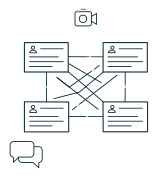
  • Hybrid fan-out chosen by account size, decided up front
  • Every action affecting reach or money stored as an event
  • Media treated as its own pipeline, not a field on a post
02

Trust and safety is product work

Moderation is often scoped as a back-office function and then discovered to be a product surface: what a reporter sees after reporting, how long an appeal takes, whether an enforcement action is explained, and how a creator who depends on the platform for income finds out that their reach has been limited. Those experiences shape retention as much as the feed does.

We build the classification and queueing to keep the backlog bounded, and the user-facing side to be honest about what happened. Enforcement decisions are recorded with the evidence and the rule applied, which is what makes an appeal reviewable and keeps decisions consistent between reviewers.

03

Launching without pretending to be large

A new social product has the opposite problem to a large one: an empty feed. The early build concentrates on a single community, seeded content, and the loops that work at low density, including direct connections, notifications that carry a reason, and content worth seeing without a ranking model behind it. Ranking arrives once there is enough behaviour for it to learn from.

Monetisation follows engagement rather than leading it, and the payout ledger is built properly the first time even at small volume, because migrating creator earnings later means reconciling real money against records that were never designed to carry it.

  • Seed one community rather than launching an empty feed
  • Introduce ranking once there is behaviour to rank on
  • Build the payout ledger correctly while volume is still small
FAQ

Social Media software questions

How do you handle the feed at scale?

With a hybrid: push a post into follower timelines for ordinary accounts, and assemble on read for accounts with very large followings where fan-out would be prohibitive. The split point is tuned against real distribution, and the boundary belongs in the design from the start because retrofitting it touches everything.

Can moderation be fully automated?

No, and a system designed as though it can will produce both misses and wrongful enforcement. Automated classification prioritises and handles the clear cases; human review handles the ambiguous ones and the appeals. The engineering is in keeping the queue bounded and the decisions consistent.

How are creator payouts handled?

As a ledger rather than a balance field. Earnings accrue as entries carrying their attribution, holds and reversals, statements are generated from those entries, and a payout is a recorded transition. That is what lets a creator query be answered precisely and a discrepancy be traced.

What does live streaming require?

Ingest, transcoding, a delivery path suited to the audience size and latency target, chat with its own moderation, and recording. It is the most infrastructure-heavy feature on a social platform, and its cost model differs enough from the rest to be worth sizing separately.

Can it integrate with existing social networks?

Cross-posting, authentication and follower import are possible within whatever each network permits through its API, and those permissions change. We build such integrations behind an interface and expect them to break, so a withdrawn API becomes a degraded feature rather than a broken product.

Plan software around your social media operation.

Share the workflows, records, exceptions and integration boundaries the system needs to support. We will help define the technical scope.